Cultivating Tomorrow
Cow Barn
At Gramsanskruti Agroservices, we are dedicated to providing exceptional services for Gir cow barns. Our expertise in designing, constructing, and managing Gir cow barns is unmatched, and we take pride in creating optimal environments for the well-being and productivity of Gir cows.
Gir cow is mentioned in the list of indigenous cows as a breed that produces a significant amount of milk. It is recognized by the name “Gir” due to its association with the Gir forest in the state of Gujarat.
However, in various regions of Gujarat, it is also known by other names such as Desan, Gujarati, Bhodali, Kathiawadi, Sorti, and Surti.
Gir cows can also be found in the Saurashtra region, particularly in Rajkot, Junagadh, Gir Somnath, Bhavnagar, and Amreli. Due to their high milk yield and nutritional quality, the conservation of Gir cows has become a priority for livestock breeders and farmers.
The milk of Gir cows fetches a higher price in the market compared to other breeds, as it is known to be rich and nutritious. As a result, the population of Gir cows has been increasing steadily.
Conservation and development of Gir cows
Out of the total population of 21,26,421 Gir animals in the country, Maharashtra is home to 10,784 Gir animals. The breed has been developed through selective breeding and conservation efforts in Brazil, leading to the development of the Gir breed.
Currently, in some places, crossbreeding has resulted in animals being identified as Gir-like due to the negligence of breeders in Gujarat. At some places, due to artificial insemination using high-quality Gir breed semen, differences in the purity of the Gir breed cows are being recognized due to natural occurrences. This requires the use of semen from superior lineage for artificial insemination to ensure the birth of high-yielding and high-quality Gir breed cows.
It is possible to increase the production and breeding capacity of Gir cows through their conservation and development. The conservation of Gir cows is carried out on a large scale in the border areas of Maharashtra and Gujarat.
Several places have seen the implementation of commercial Gir cow development projects. The Maharashtra Animal and Fisheries Development Corporation (MAFDC) under the Maharashtra government’s Animal Husbandry Department is making available semen from high-quality Gir bulls through the Akola-based organization, facilitating the breeding of high-yielding Gir breed cows.
Compared to foreign breeds, there is a growing emphasis on the nutritional richness and essential supplementary components required for healthy health in indigenous cow milk. This has led to a widespread focus on the conservation of indigenous cows.
Benefits of Gir Cow Milk
01
Excellent for Hair Healthy
Gir cow milk provides excellent nourishment for hair. It is highly beneficial for those who suffer from hair fall issues. The milk is rich in vitamins, especially vitamin D and zinc, which are crucial for hair nutrition. The presence of these vitamins in Gir cow milk significantly contributes to the nourishment of hair. As a result, it helps in reducing hair fall and promotes strong and lustrous hair.
02
Strengthens Bones
Gir cow milk is rich in calcium and magnesium. This makes it extremely important for improving bone strength. When young children are given Gir cow milk, it greatly enhances the growth of their bones. People who regularly consume Gir cow milk have observed faster healing of bone injuries and a lower incidence of bone-related ailments.
Description of Gir Cow
-
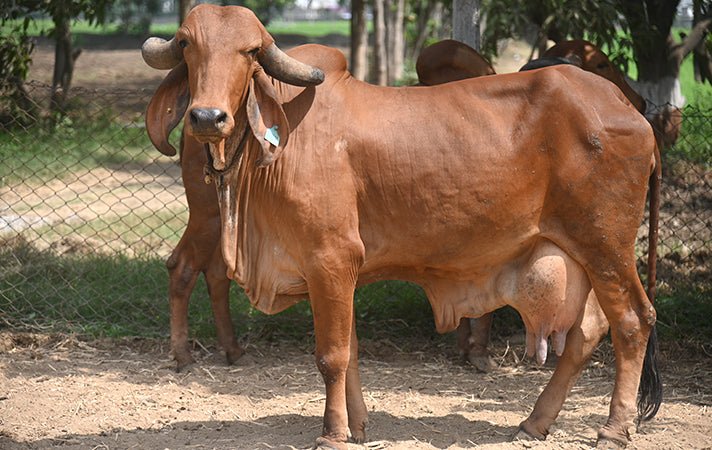
Gir cows have a generally reddish-brown and white coat with white markings on the face and a white patch on the belly.
-
The hump protrudes forward below the neck and then curves backward towards the tail. It appears in the shape of a semi-circular arc. The origin of the hump in these cows starts from the shoulder blade area.
-
The ears are long and drooping, resembling a leaf shape. The inner part of the ear is always visible. The ears of Gir cows can be as long as 30 cm.
-
Having a small opening at the end of the ear is considered a good characteristic of this breed.
-
The dewlap of Gir cows is similar to the shape of an inverted pot and extends forward towards the forehead. The face is long, and the eyes are almond-shaped. Due to the eyelashes, the eyes appear half-closed.
-
A greater distance between the eyes is considered a good trait. The chest is broad and deep. There are folds on the chest and very delicate and soft skin. The skin also has oil glands, which help regulate body temperature.
-
The hooves are black and concave. Some cows may have dewclaws extending to the ground.